
Baseline

Findings · how the record is kept today

Football and basketball still run on paper

Not as a fallback. As the official record — the document a governing body and a disciplinary panel actually act on.

Football

A notebook and two coloured cards

The referee writes the player’s details in a small notebook — which is why a caution is called a booking. Cautions and dismissals are then re-entered after the match into the FA’s Whole Game System or FA Full-Time.

Source: The FA, Law 5 and referee reporting guidance
Basketball

A paper scoresheet and four people at a table

FIBA’s Table Officials Manual makes the scoresheet the official record of the game. A scorer, assistant scorer, timer and shot-clock operator tally baskets, fouls and timeouts by hand; scorers are told to carry notice paper for incidents.

Source: FIBA Table Officials Manual v3.2

Tennis

The exception that proves the point

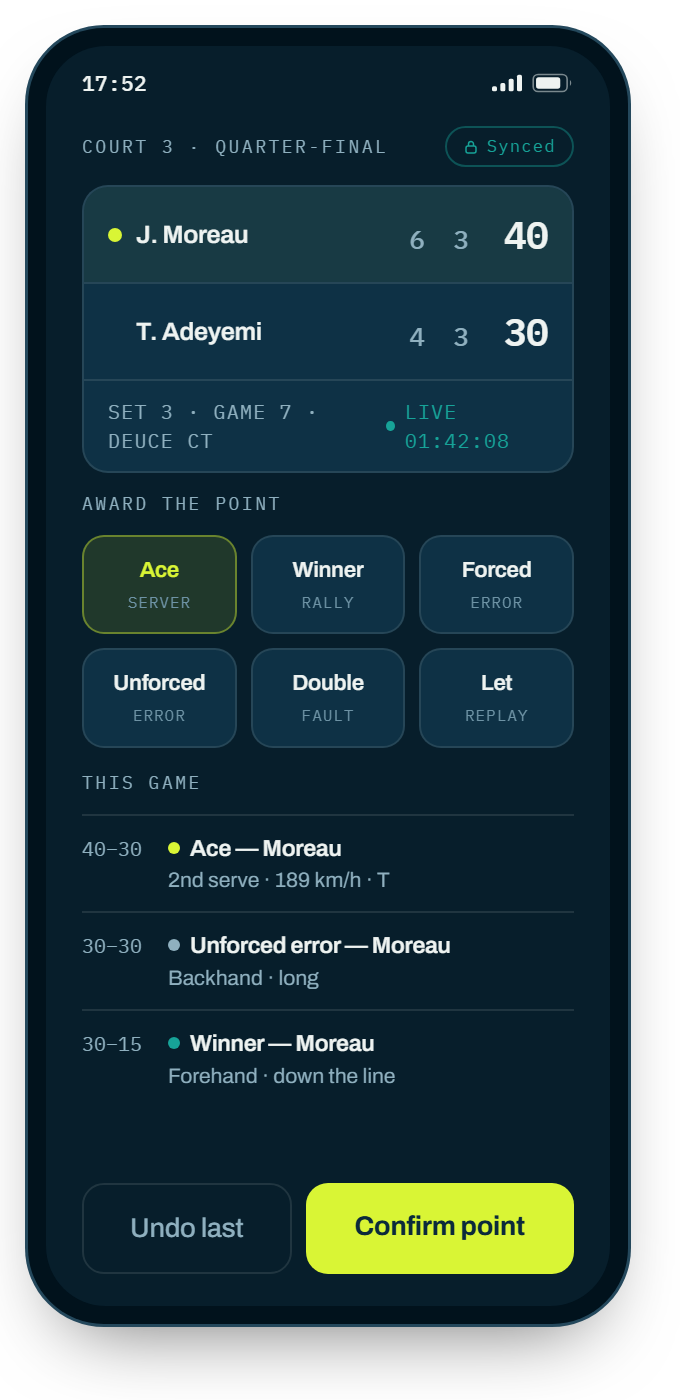
Chair umpires already score point-by-point on a dedicated tablet, and the ITF delivers live data straight from the chair at more than 1,200 Pro Circuit events a year. It works — it is just one sport, one chair, one proprietary stack.

Source: ITF Pro Circuit live scoring; Wimbledon officiating

Football and basketball keep the legal record of a match on paper. Tennis shows exactly what happens when you put it on a device instead — and nobody has generalised that beyond one sport.

The premise

Sport spent fifteen years automating the call. Nobody automated the record.

Cameras now decide where the ball landed. A human still writes down who scored it, who assisted, who was cautioned and why — and in most of world sport, still writes it on paper.

What changed

Fifteen years of officiating technology

Read it top to bottom. The point is the weight and consistency of investment across five different sports — and that every entry decides a call rather than keeps a record.

  1. 2013

    Goal-line technology

    Premier League adopts Hawk-Eye across all 20 clubs. 14 cameras; the referee’s watch buzzes in under a second.

  2. 2014

    NBA Replay Center

    Every reviewable call routed through one facility in Secaucus, New Jersey.

  3. 2017

    Electronic line calling

    Live ELC trialled at the Next Gen ATP Finals in Milan.

  4. 2022

    Semi-automated offside

    FIFA deploys SAOT at the men’s World Cup in Qatar.

  5. 2022

    Player data rights

    FIFPRO launches its Charter of Player Data Rights, setting global standards for how player data is held.

  6. 2023

    NBA × Hawk-Eye

    3D optical tracking of every player and the ball, from the 2023–24 season.

  7. 2025

    Tennis retires the line judge

    ATP adopts ELC Live tour-wide; Wimbledon follows. Premier League adds SAOT in April.

  8. 2025

    NFL retires the chain gang

    Six 8K cameras measure the line to gain, run from the league’s central officiating centre.

Sources: Premier League; ATP Tour; NBA; FIFA; FIFPRO; ESPN; Sky Sports.

The gap

Every one of those systems answers the same kind of question

What cameras answer

Where did the ball land?

Did it cross the line?

Was the attacker ahead of the last defender?

Geometry. Answered definitively, in under a second.

What nothing answers

Who scored it?

Who assisted, and with which foot?

Who was cautioned, and for what reason?

Judgement and record. No camera writes these down. An official does.

Baseline scoring a live tennis match point by point, with aces and unforced errors.
Tennis · the counter-example

The cost

Four hops from the card to the governing body

  1. 01

    Paper team sheets

    Handed over in the changing room, photographed if you are lucky.

  2. 02

    A notebook in a pocket

    Cautions, substitutions and scorers, written between restarts.

  3. 03

    Post-match re-keying

    Typed into a league portal hours later, from memory and shorthand.

  4. 04

    Spreadsheets by email

    Passed between club secretary, registrar and federation.

Four hops

Between the moment a referee raises a card and the moment a governing body can act on it.

Every hop is a chance to lose a caution, mis-attribute an assist, or delay a suspension — and none of them leave an audit trail.

What replaces it